The Little War
as seen in The Boys Book of Adventure

I had written the following short for The Boys Book of Adventure, which had been published earlier this year to the hearty approval of young men across the board. With permission, The Little War has been reproduced below in its entirety, free for my own subscribers (and their youngsters) to enjoy. If you haven’t already, you can pick up your physical copy here.
Peter stood to his feet to appreciate his battlefield from a fresh perspective. He had spent the better part of his morning setting up an incredible display of encyclopedias from his father’s study, and storybooks from his own bookshelf, each of them being of various sizes strewn upon the nursery floor, some in stacks and others carefully leaning in a clever array. If not for the coloured armies of tin soldiers and spring-loaded cannons which had decorated them, a grown-up might have mistaken this chaotic arrangement as evidence of a burglary. But to Peter these were no common debris. Each of these objects had been assigned a sacred purpose. From henceforth, these books would be churches and schoolhouses, barns and bridges, ridges and valleys, each of them painstakingly placed throughout their respective countryside, ready to realize their maker’s purpose.
It was in the thick of his self-appreciation when he heard the door creak open behind him, from which his little sister Rose emerged.
“What are you doing?” She asked.
“Playing.”
Her eyes scanned the room as she took note of the bare bookshelves, their contents having been emptied across the floor and even under the bed. Her eyes lit up at the sight of her wooden blocks which had been carefully stacked into a wall, hiding a unit of British redcoats.
“It doesn’t look like you’re playing.” She challenged.
Peter sighed. “I’m making a game.”
“Can I play?”
“No, Rose. You won’t follow the rules.”
“Yes, I will!” She started with a sob. “If I can’t play, I’m taking my blocks back.”
Peter knew that once his sister started with the whine, a quivering lip was not far off. And that was all it would take to get their mom in the room, which would almost certainly result in a talking to about being the older sibling.
“Fine!” Peter conceded, visibly annoyed. “But you have to be Napoleon.”
“What colour is that?”
“Blue.”
“That’s not fair! There are so many red guys. Why can’t you give me some of your red guys?”
“You can’t mix British and French!” Peter replied sharply. “It doesn’t matter anyway. Napoleon has a fort so he’s stronger.” As he said this, he pointed to an emptied sea chest which had been tipped over and emptied of its former contents. Inside were a few blue soldiers. “The guy with the flag is Napoleon.”
“But doesn’t Napoleon have a funny hat?”
“I don’t have one that looks like that, so I’m pretending he’s The General.” Accepting that he was now going to be assuming the offensive, Peter furrowed his brow. He was determined to punish his sister for intruding upon his wargame; that she would know once and for all that he was not to be trifled with when it came to matters of battle.
Rose looked dissatisfied. “Who’s your general?”
“He’s hiding.”
“That’s not fair!” Rose protested. “Is it one of the guys behind the blocks?”
Peter cringed. “You’re not supposed to be looking around. If you want to play, then get over to your fort.”
Rose wiggled her eyebrows up and down, silently boasting that she had just exposed her brothers plans.
“You have to follow the rules if you want to play. When its your turn, these guys can move one foot.” He said this motioning to the infantry soldiers as he handed Rose a twelve-inch wooden measuring stick. “They can bring a gun with them as they move, but it makes them slower so they can only move half a foot per turn.”
“Don’t they all have guns?” Rose asked in earnest.
“Not rifles! Guns!” he held up one of his spring-loaded breechloader cannons to demonstrate the difference. This was a wooden toy cannon with miniature wheels. It was painted black and bronze coloured, with the initials four-point-seven carved into its base. As he held it up to his sister, he pressed a button causing a wooden projectile to fly across the room, hitting the bedpost with impressive force.
Peter shuffled over on his knees to retrieve the wooden cylinder to reload his gun. “When you shoot, you can’t take your gun off the ground. You have to turn this thing at the back to adjust its height and angle.”
“That looks hard.”
“Its so easy.”
Rose looked unconvinced.
“Oh, and you can move cavalry two feet on your turn, or one foot if they’re pulling a gun. Are you ready?” Peter asked with a grin. He was becoming increasingly sure of a pending victory. So much so, that he gave his sister the first turn, nudging her to pick up the ruler from where she had placed it on the floor.
Picking up the ruler, Rose began a crude census of her forces. Three cannons, five ‘horse guys’ and twenty-two men. Her blue country – as she called it – was obviously dwarfed by her brothers red country. But she did have the fort, she reasoned. And so, she proceeded to move her men.
Peter grinned as he watched Rose unwisely mobilize her entire army out of the box; every piece but her general which she cautiously hid. Perhaps she thinks he’s worth more points, Peter thought without offering any correction. He wasn’t playing for points. In this war, he planned on taking no prisoners.
Rose finished her turn with three cannon shots, each missing but getting closer to the mark every time. But her men were left exposed and at the mercy of her brother who was determined to make an example of them.
It was now Peter’s turn, and he gleefully snatched the ruler from his sisters hand.

The stage of the final battle had been set. Finally, after a grueling five years of war, they had the French Emperor on the run. Napoleon Bonaparte was holed up in an old castle, clinging like a dog to his stolen Prussian gold. But surely this was the end of the line for him. General Wellington would see to it that ol’ Boney would never threaten them again.
Just as Peter positioned his cavalry, flag-bearers and drummer boys, General Wellington rode out to the front of his troops for one final speech.
“I don’t need to tell you men just how much this means to your country,” Wellington spoke valiantly. “To your families back at home, and to good King George whom you’ve all so fervently obeyed. As volunteers you have come so far, over moor and mountain to prove your worth, and now we knock at the very door of victory, ready to put to shame the Scourge of Europe. Hark now! Beat the drums once more! For we ride to victory!”
Sabres rattled as the men erupted in passionate cheer, happy warriors each one of them, ready to serve their king and country once more, and to lay down there lives if need be.
The British units mobilized their artillery into battle position, strategically perching them atop a ridge, while troops of infantry bravely closed the gap between their commanders and the French guns.

Rose started to whine that she had been lured into something beyond her expectations. Peter paid her no mind.
“What happens if your guys touch my guys?” she asked, hoping to uncover some hidden advantage.
“That’d be a sword fight. Or a bayonet. I guess we’ll flip a coin for each soldier to see who wins.” Peter responded offhandedly. So assured was he in his final victory that he hardly cared for a few hand-to-hand casualties. “Oh! I forgot to say, if I’m within one foot of your guy I can take a shot.”
“You didn’t say that?” Rose immediately protested.
“Its okay. You can shoot at me if I miss.”
Rose was becoming noticeably frustrated as Peter produced a six-sided die from his pocket. “For every two inches away my guy is from yours, I need a higher number. So, I need to roll a six if I’m a full foot away, or a five if I’m ten or more inches away, or a four if I’m eight inches away. You get the point.”
Rose didn’t get the point, and her anger intensified as she watched her brother measure the space between their lines, perform some silent arithmetic, and then roll his die to knock down her figures, which he did, one by one. Seeing her infantry dwindle, Rose pulled one of her guys away before Peter could knock him over. A fight erupted when Rose claimed that her guy dodged a successful roll.
“This isn’t fair! You didn’t tell me the guys could shoot! You only talked about the cannons!”
“Fine.” Peter conceded, comfortably. We’ll just put the guys who got shot this round in prison instead of killing them. Does that make it better?”
This little olive branch caused his chest to puff out a little, as he discovered his previously untapped gift of diplomacy.
Rose sniffled and quenched a brewing tear.
“Here.” Peter picked up all Rose’s fallen soldiers and put them into an emptied tissue box. “They’re just prisoners of war now. Can we keep playing?”
Rose nodded, thankful for her brother’s concession.
Peter placed the tissue box down at the side of the battlefield, rattling its occupants with a self-congratulatory grin. So pleased was he with his newfound merit, able to bridge the gap from soldier to politician, that he began to consider his own rank; if Wellesley could go from general to prime minister, perhaps this was an option for he as well.

One by one, the British riflemen were able to pick off the Frenchies like sitting ducks until there were only three isolated infantrymen left. Then came the cannon fire, which decimated the French cavalry and rocked Napoleon’s castle walls. Surely victory was in the air for the faithful redcoats!
As the cannon smoke began to smother the battlefield, Wellington decided to taunt his enemy.
“Is this La Grande Armée which brought Europe to its knees?” he mocked.
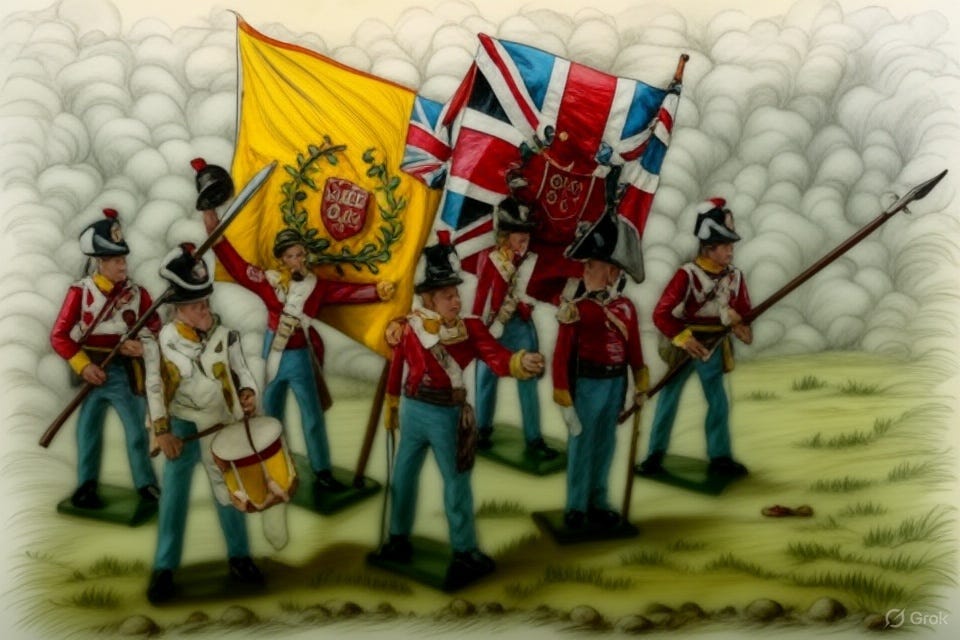
So puffed-up and self-assured had Wellington become that he had forgotten a simple surety – that war breeds fog. And Napoleon’s forces were not about to sail peacefully into the sad goodnight.
Instead, like men possessed, those three surviving foot soldiers flashed their sabres as they charged valiantly at the British army, deciding it better to face them head on.
Who should deny them a good death? Wellington thought.
Like three blue specks, those brave blue soldiers clashed against a sea of red.
However, much to the surprise of Wellington, who was watching from atop the ridge, those blue specks remained on their feet as one by one the redcoats took casualties.
With every flip of the coin, heads came up rather than tales – four times! five times! six times!
Heads came up a miraculous twenty-one times in a row!
The legitimacy of these coin tosses was about to be called into question when finally, one of the frenchies fell. Then a second. But not before slaying thirty-five of the British men. Leaving only five left on their feet to the surviving French hero. But alas, he was not permitted to move any further this turn.
Now, much to the chagrin of Wellington who was looking onward in disbelief, the surviving French cavalry began to ride out to the British prisoner’s camp; the French horses were able to reach the prison with ease.

“What are you doing?” Peter protested, breaking character.
“Prison break.” Rose replied, quite impressed with herself.
“What do you mean, prison break? There’s no rule for that?”
“Then what was the point in keeping them in prison instead of killing them?”
“Just to make you happy.”
Ignoring her brother, Rose dumped the contents of the box onto the floor, freeing her men from bondage.
“That’s cheating!”
Suddenly Rose became furious and reached out to hit her brother on the arm, which he evaded. She then stormed out the room calling for their mom. Peter found himself in a frustrating but all too familiar position. Putting his ear to the ground, he could hear the muffled sounds of his sister complaining to their mom, doubtless about his insufferable cruelty as a big brother. But then came the dreaded verdict loud and clear. Peter’s countenance sunk.
“Settle it with rock, paper, scissors.”
He heard his mom’s judgement, and he knew it was meant to be fair without having to wade into their sibling skirmish. But he was nonetheless at a disadvantage, for he always somehow lost at rock, paper, scissors.
Peter soon heard his sister’s satisfied footsteps coming up the stairs, then gaily skipping down the hall.
Peter gulped back air as he rushed a thought. He always started with rock, and she always started with paper. And whenever he asked for best out of three, his request was denied. This time would be different. This time he would start with scissors. It was determined.
Rose entered the room with a cheeky grin.
“Mom said we have to settle it with rock, paper, scissors.”
“Good.” Peter replied. His sister cleverly noted his confidence.
“No do-overs,” she qualified, putting out her closed fist.
“I don’t want any do-overs.” Peter responded, meeting her fist with his. Then came the customary countdown.
“Rock, paper, scissors, shoot!”
Peter had thrown scissors and immediately grunted with dissatisfaction.
“Argggghhhh!” was the moan he gave.
Rose had thrown rock.
Rose chuckled and started to set up her newly liberated infantry and cavalry in the midst of the battlefield where the prison had been. Helplessly, Peter watched as his earned victory thus far had become undone.

“Righty-ho, then!” Wellington exclaimed. “Turn the guns toward our flank!” he ordered.
“Turn the guns to the flank!” The order echoed through the line.
From atop the ridge, their angle and range were adjusted to their extremes to target their resurrected foe.
Wasting no time, the order was given. “Fire!”
But as the cannon fire rained down upon the French, the downward angle of the shot from atop the ridge proved too difficult to overcome. Most of the projectiles simply sailed over the newly established French line.
Seeing his heavy artillery come to no avail, Wellington gave the order for his cavalry to ride out with him and overwhelm the enemy. Here they would seal their victory, once and for all.
But much to their misfortune their turn would end before they could descend the high ridge and reach the enemy line.

“You should have measured before you moved.” Rose taunted.
Peter turned red in the face. His turn was over and his cavalry had been left exposed.
With only a skeleton crew remaining, Rose easily positioned her guns toward the cavalry and fired at will. The British ranks were decimated. But worst of all, Wellington himself would be counted among their dead.
Peter was stunned. Surely no mere benediction would suffice for this solemn occasion. His mind jumped to the familiar painting which hung proudly in their father’s study, The Death of General Wolfe. Surely this was a death scene befitting England’s greatest soldier. And so, akin to that fateful moment which had been so ably captured on oil and canvas, Peter began to recreate those faraway and besieged Plains of Abraham with tin soldiers, but with no less pomp and circumstance.
No protest was given as Peter’s flagbearers and drummer boys were permitted a free move to gather themselves to their fallen hero.

As cannon balls ripped through the sky, exploding upon the grounds before them, Wellington lay sprawled out on the floor, humbly resting his head in the lap of one of his faithful flagbearers.
“Alas, I am poured out like water,” he spoke, recognizing his impending demise. But Wellington considered it improper to focus upon his own undoing, for this was not the English way, no less for a British officer. Instead. Wellington stiffened his upper lip and with his dying breath he implored his men – that they would never surrender; that they would press onward to victory.
Then, Wellington gave up the ghost.
“Woah to our wives and children if we should suffer defeat this day!” the British soldiers collectively cried out. “For there will be nothing standing between them and ol’ Boney from destroying them.”
Their greatest soldier had fallen. But this only caused greater resolve amongst their ranks.

Rose smiled as Peter seemed to be dramatizing this turn of events to her favour without objection. If only he would always play this fair, she thought.
But then, to her confusion, Peter smiled. “Now its my turn,” he said.
Rose looked perplexed; she always wore her feelings on her face. But as Peter reached behind the block wall to produce reinforcements, her countenance changed from bewildered to beleaguered.
“That’s not fair! You can’t just keep having more guys. You already had way more guys than me.”
“You already knew about these guys.” Peter justified. “Said so yourself. Besides, that wasn’t really my general. It was an imposter to fake you out. Wellington would never run into cannon fire.”
“Arrrrrrrggghhhh!!!” Rose growled in anger as she stormed out of the room a second time, making sure to knock over the wall of blocks on the way out.
But this time, Peter didn’t care. He simply closed the door behind her and continued with the game, bringing his army around the rubble to the doors of Napoleon’s stronghold. Only he knew he was on a time crunch before Rose would come back with another judgement rendered remotely from their mother.
And so the little drummer boy, who was secretly the real Wellington, quickly swam the castle moat and scaled its impenetrable walls while fellow his soldiers looked onward in awe, saluting the lad’s bravery, and remaining unaware that their general yet lived.

Lowering himself to the castle floor, Wellington marvelled at the Frenchman’s draconic greed, for stolen Prussian gold, more than an army could spend in three lifetimes, had been hoarded here to one man’s vanity.
Suddenly, from behind a mountain of gold, emerged a man in a blue coat, holding a French flag.
“Sacre bleu!” he shouted in alarm. “Who are you?”
“I am General Wellington, come to send you to your maker.”
“No, rosbif!” Napoleon laughed, as he observed his intruder’s drummer boy attire. “I think you are not.”
Wellington responded only with a prolonged steely gaze, causing Napoleon to stagger.
“If you’re the real Wellington,” Napoleon finally challenged, “then where are your general’s stripes?
“Where’s your stupid hat?” Wellington shot back sharply.
“Touché!”
The two great men stood in silence.
“So, you are Wellington. What will you do then? Have you come to hornswoggle my gold from me?”
“Why you little, pigeon-livered man. You are not the lawful keeper of this treasure, but a thief who has robbed all of Christendom.”
With that Napoleon threw himself at Wellington like an enraged rooster, but Wellington was too quick, producing a sabre from its sheath and running the menace through.
Napoleon was dead. The real Wellington had seen to it personally. Soon, all would be made right in the world.
Lowering the drawbridge to the stronghold, the little drummer boy welcomed the British army to reclaim the plunder. Celebration erupted when the surviving redcoats discovered that their general was not only still alive, but that he had also slain their enemy and won the Prussian gold back. Surely, Wellington would be knighted for this!

“Mom says its time to clean all this up!” Rose spoke abruptly as the door swung open. She wore the face of a young woman scorned. “You’ve been hogging this floor all day.”
Satisfied in his game’s epic conclusion, Peter thought it not worth the words to rebut. Diplomacy means picking your moments, he thought. Besides, his epic game was now through, and his father would be home soon wondering why the volumes of encyclopedias had been strewn across the floor, in a seemingly careless array.
Books were important to his father and were to be regarded with respect, a respect which Peter had nobly upheld.
“You can have the room back,” Peter replied. “if you help me clean up.”
This was a fair deal.
Back to hopscotch and marbles, no doubt, Peter sighed. But from that day onward, he would never regard the nursery floor the same; once baptized in the blood of nameless heroes, and then sanctified by the triumph of good over evil.
End.
This story is dedicated to H.G. Wells who never let adulthood get in the way of a good round of toy soldiers. Click here to see what I mean.
Thanks for reading The Little War. If you enjoyed it, I would encourage you to grab a physical copy of The Boys Book of Adventure through the link below. Its chock full of fun tales for boys of all ages, a demographic which is criminally under-appreciated by publishers today. On that note, The Boys Book makes a superb gift for youngsters needing some encouragement to read! It usually just takes the right book.
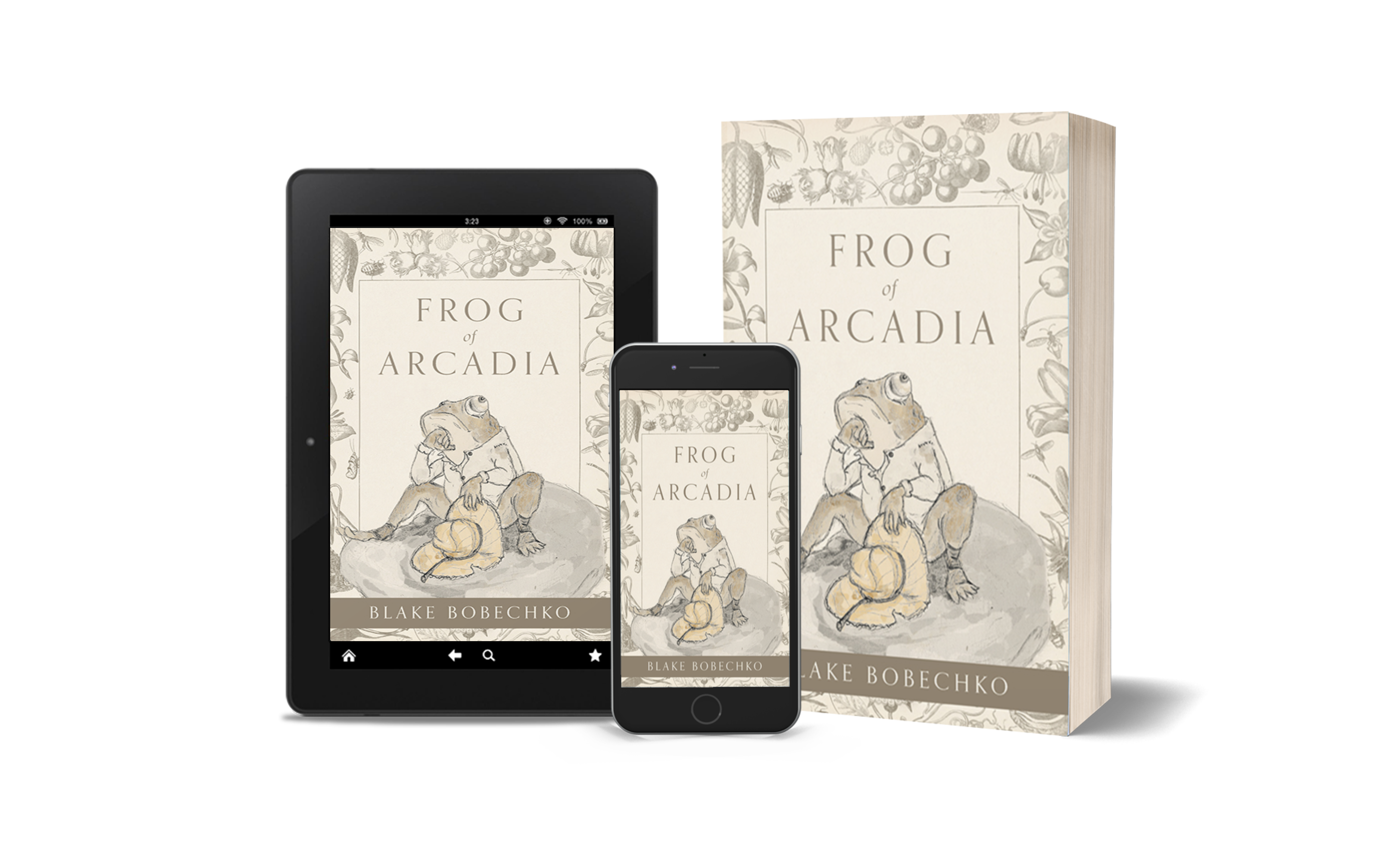
While you’re at it, why not pick up a copy of my first novel Frog of Arcadia. You can find it wherever books are sold. But for ease, here’s a link.